 Climate Response
The Climate Insurance for Smallholder Farmers in Indonesia (CISFI) program is an index-based initiative, designed to provide faster and more transparent protection for smallholder farmers impacted by climate change. Through parametric insurance, farmers are protected from the risks of extreme weather events, such as drought and flooding, which are becoming increasingly frequent due to climate change. CISFI serves as a solution by providing automatic financial aid based on pre-defined weather parameters that affect agricultural yields—like rainfall, temperature, or soil moisture—eliminating the need for complicated claims procedures.
The program is being implemented in two provinces: West Java (Karawang Regency) and East Java (Malang Regency). The primary advantage of CISFI is its ability to provide direct compensation to farmers, making it easier for them to recover from losses caused by extreme weather. If rainfall exceeds or falls below a pre-defined threshold, farmers automatically receive a payout without having to prove physical damage to their land. This simple and rapid claims process allows farmers to immediately resume their farming activities without enduring a lengthy and convoluted claims procedure.
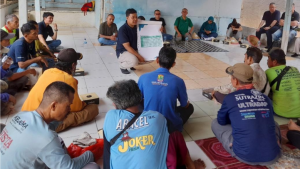
This ensures that farmers can focus more on recovering their operations with greater peace of mind. Furthermore, the CISFI program offers a high degree of transparency, as financial aid is distributed based on objective and easily measurable parameters. By utilizing weather data that is accessible to all relevant stakeholders,this system reduces administrative costs and accelerates the distribution of aid to farmers in need. Consequently, farmers can be more confident that the assistance they receive is fair and directly relevant to the conditions they experience on the ground. To date, the CISFI program has reached 21,071 conducted insurance literacy socialization for 21,071 farmers, with 4,907 farmers purchasing insurance policies, protecting 5,098 hectares from climate change risk.